
Species Care Sheet
Heavy Jumping Spider
Hyllus diardi
Intermediate to keep
The spider
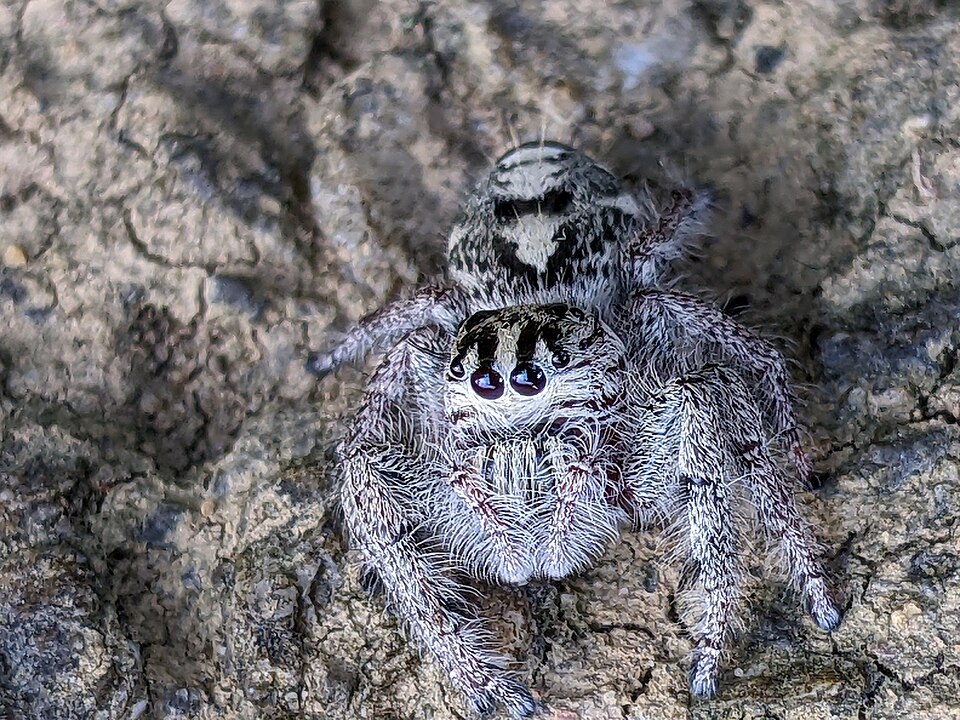
The heavy jumper is the show-stopper of the group, a robust, big-legged spider from South-East Asia that stops people mid-sentence. It is heaviest by bulk and legspan rather than record length, so a large regal female can match it for body length, but nothing matches its presence. It is an intermediate keeper's spider rather than a first one, since it wants more warmth and moisture than a Phidippus and is almost always imported, which makes captive-bred stock worth seeking out. Keep a regal through a molt or two first.
Home and environment
Give it a larger, tall, front-opening enclosure, at least 8 x 4 x 12 inches, with cork bark, sturdy branches, and broad leaves to climb and anchor its web. This is the one species here that wants higher humidity, around 70 percent, but only with strong cross-ventilation on two opposite sides, since a stuffy, wet tank kills faster than a slightly dry one. Use a deeper one to two inch layer of coconut fibre to hold the moisture, a bright but indirect spot to keep its appetite up, and never direct sun.
Feeding
Its size lets it take larger prey than a Phidippus, still nothing bigger than its abdomen. Feed large fruit flies and houseflies when young, then appropriately sized crickets, roach nymphs, and bottle flies. The one firm rule is prey no larger than the spider's abdomen. How often each one eats depends on its size and its last molt, so I do not print a schedule here. Every spider goes home with one, and I am glad to share mine if you ask. Feed to body condition rather than the clock; a plump abdomen means skip a meal. Remove any uneaten insect within a day, since leftovers foul a humid tank quickly.
Molting
When it is time to molt, the spider seals into a thick silk hammock, usually high in the enclosure, and stops eating for days to over a week. Do not feed it and do not disturb the retreat, and remove any live insect at once, since a cricket can kill a soft, defenceless spider. For two to three days after the molt the new body stays soft, so leave it alone until it is hardened and hunting again. Keep the humidity toward the upper end while it is molting, since dry air can cause a stuck molt in this species.
Temperament and handling
Sources differ on its temperament, some calling it calm and others more reactive and quick, with a larger but still harmless bite. For a shop it is safest treated as a display spider first. If you do handle it, go low, slow, and over something soft, and never before a molt, in its first week home, or for a few days after a molt. Its size and jumping distance make a fall onto a hard floor reliably fatal.
What to avoid
- High humidity without ventilation, which turns to mould and stagnant air
- The opposite mistake, letting it get too dry, which causes stuck molts
- Sustained temperatures below about 72F, which stop it feeding
- Prey larger than the spider's abdomen
- Leftover feeders fouling a humid tank
- Handling over a hard surface, where a fall is fatal for a spider this size
- Buying wild-caught imports, which arrive stressed and may carry mites
“This is the one that stops people mid-sentence, all bulk and bright fangs. Give it warmth, moving air over gentle humidity, and captive-bred stock, and it rewards you with the most commanding presence in the collection.”
More care sheets · Regal Jumping Spider · Bold Jumping Spider · Canopy Jumping Spider · Johnson's Jumping Spider
Care notes reflect the r/jumpingspiders keeping community's consensus, cross-checked across hobby care resources. Every animal is an individual; watch yours and adjust.
Keep your own record
Everything on this page is what I have learned keeping them. The Keeper is where you can write down what you learn keeping yours: meals, molts, water, and the little milestones. Free for three.