
Species Care Sheet
Bold Jumping Spider
Phidippus audax
Beginner to keep
The spider
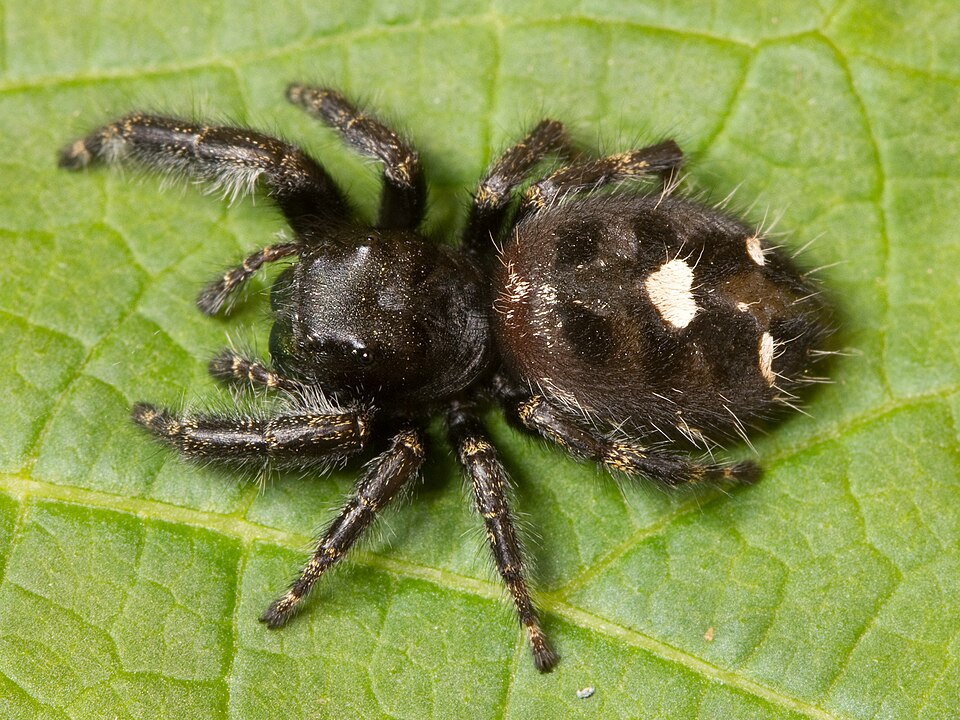
The bold jumper is the common native across most of the United States, and every bit as charming as the imported regals. It is a little smaller, with a black body marked by a white or orange triangle on the abdomen and chelicerae that shimmer green or blue. Its care is effectively the same as a regal. Because it is so easy to catch outdoors, many people start with a wild adult of unknown age; a captive-bred one is younger, calmer, and free of the mites and nematodes wild spiders often carry.
Home and environment
Set it up like a regal: a tall, well-ventilated, front-opening enclosure with cross-ventilation on two opposite sides, a cork slab or branch to climb, and a high anchor for the retreat over a thin layer of barely-damp coconut fibre. As a temperate native it is comfortable at ordinary household temperatures and does not want a wet tank. Airflow over humidity, always, and seal every gap.
Feeding
Feed flightless fruit flies and springtails to slings, then small crickets, bottle flies, and roach nymphs, with waxworms only as a treat. The one firm rule is prey no larger than the spider's abdomen. How often each one eats depends on its size and its last molt, so I do not print a schedule here. Every spider goes home with one, and I am glad to share mine if you ask. Feed to body condition rather than the clock; a plump abdomen means skip a meal.
Molting
When it is time to molt, the spider seals into a thick silk hammock, usually high in the enclosure, and stops eating for days to over a week. Do not feed it and do not disturb the retreat, and remove any live insect at once, since a cricket can kill a soft, defenceless spider. For two to three days after the molt the new body stays soft, so leave it alone until it is hardened and hunting again.
Temperament and handling
Despite the name, it is calm rather than aggressive and tolerates gentle handling once settled. Some find a bold jumper a touch more flighty than a laid-back captive-bred regal, largely the difference between a wild spider and a home-raised one. Use the same method: let it walk onto an open hand, low and over something soft, and stop if it crouches, raises its front legs, or drops a dragline to flee.
What to avoid
- High humidity with poor airflow, which breeds mould and stresses the lungs
- Leaving live prey in while the spider is sealed up to molt
- Prey larger than the spider's abdomen
- Handling over a hard surface, where a fall can rupture the abdomen
- Unsealed lids and vents they escape through
- Housing two together, which ends in cannibalism
- Skipping a two-week quarantine on any wild-caught spider, which may carry mites or nematodes
“Our native bold jumper is just as delightful as the imports, only a little smaller. Buy captive-bred rather than grabbing one off a fence post, and you get a young, healthy spider instead of a stressed adult that may already be near the end of its year.”
More care sheets · Regal Jumping Spider · Canopy Jumping Spider · Johnson's Jumping Spider · Heavy Jumping Spider
Care notes reflect the r/jumpingspiders keeping community's consensus, cross-checked across hobby care resources. Every animal is an individual; watch yours and adjust.
Keep your own record
Everything on this page is what I have learned keeping them. The Keeper is where you can write down what you learn keeping yours: meals, molts, water, and the little milestones. Free for three.